
In the B2B marketing landscape, the influencer economy has just undergone its most volatile transformation yet. For years, brands viewed influencer partnerships through a lens of aspirational lifestyle content. However, the first five months of 2026 proved that without robust web and social media analytics, these digital assets can rapidly transform into systemic corporate liabilities.
For modern CMOs and PR strategists, understanding the pivot from “lifestyle trend” to “social scandal” is no longer a peripheral concern—it is a critical pillar of brand safety and corporate risk management. Using advanced social listening data, we look into the internal analysis of the Greek influencer ecosystem from January to May 2026 to uncover how brands can protect their digital footprint.
1. The Shift from Lifestyle to Liability: An Overview of the 2026 Crisis
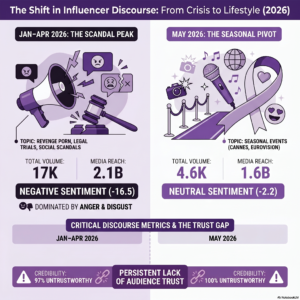
Synthesizing the digital climate of January–April 2026 reveals an online discourse dominated not by consumerism or product reviews, but by judicial disputes and high-profile social scandals. Through deep-dive web monitoring, the conversation shifted heavily toward moral and legal accountability.
This toxic environment was defined by specific, high-volume keywords across Greek social networks:
- Dubai (“Ντουμπάι”): 1.1K+ mentions
- Revenge Porn: 359 mentions
- Trial (“δίκη”): 264 mentions
- Thefts (“κλοπές”): 209 mentions
The Strategic Takeaway for Brands
When a digital ecosystem is poisoned by criminal or high-level ethical controversy, the resulting negative sentiment creates a contagion effect. Without real-time social media monitoring, any associated marketing spend can be instantly devalued.
2. Quantifying the Outrage: Sentiment and Emotion Analysis
For reputation managers, tracking Emotional Volatility in real-time is the only viable method for preventing brand contagion. While standard sentiment analysis provides a high-level view of public favorability, granular emotion analytics identify the exact nature of a reputational threat.
[Jan-Apr 2026] Sentiment Average: -16.5
(Punctuated by a massive negative spike between late February and early March)
Deciphering the C-Suite “So What?”
A strategic evaluation of the dominant emotions—Anger and Disgust—reveals critical insights:
- Unlike Sadness (which can evoke sympathy) or Boredom (which leads to irrelevance), Anger and Disgust are active, high-arousal emotions.
- They drive damaging secondary behaviors such as consumer boycotts, aggressive commenting, and structural demands for brands to sever ties.
- Disgust, in particular, creates a psychological “stigma” that is notoriously difficult to erase from a brand’s portfolio.
3. The Surprising Demographics of Digital Moral Indignation
A common failure in legacy crisis management is relying on outdated demographic assumptions. Brands often assume influencer scandals are confined to “youth and lifestyle” audiences. However, our audience analytics during the 2026 crisis revealed a massive demographic shift toward segments with significant societal and purchasing influence.
Expected vs. Actual Audience Engagement
- Gender Split: 55.2% of commenters were Male, while females accounted for only 15%.
- Age Distribution: The single most active participating age group was the 40+ segment.
This data proves that the crisis moved entirely out of “fan culture” and into the realm of general moral indignation. At the center of this digital firestorm was influencer Ioanna Touni (garnering 2.9K mentions), becoming the focal point for an older, male-dominated demographic that traditionally exists completely outside the standard influencer marketing funnel.
Palowise Insight: When a crisis spills over into older, traditionally “non-target” demographics, the reputational risk becomes systemic, as it enters the consciousness of a broader, decision-making public.
4. The Arena of Conflict: X (Twitter) vs. Online News
Effective omnichannel monitoring requires an understanding of where “viral toxicity” actively breeds versus where it is merely archived. During this period, different platforms played distinct roles in the crisis lifecycle.
| Platform | Metrics & Strategic Role |
| Online News | 55.8% Content Volume
The primary “Volume Generator” and source of long-term SEO persistence. |
| X (formerly Twitter) | 7.2K Total Mentions
The “Absolute Arena” of reaction, viral velocity, and real-time intensity. |
While Online News sites generated the highest overall volume of content—serving as the structural engine of the story—X functioned as the battleground for active conflict. With 7.2K results on X compared to just 870 results for the leading news site, the intensity of the backlash was concentrated in a space built for rapid, unfiltered sharing.
For brands localized to the Greek market (79.6% of the total conversation), X is where the reputational bleeding occurs in real-time, while news sites create the permanent digital footprint that haunts Google search results for years.
5. From Crisis to Stabilization: Analyzing the May 2026 Pivot
Identifying true Reputational Stabilization is crucial for determining when it is safe for a brand to re-enter the market. By May 2026, our data analytics signaled that the crisis had moved into a latent phase:
- Total mention volume dropped to 4.6K.
- The Sentiment Average shifted toward a “Neutral” -2.2.
- The emotional landscape transformed, with Joy rising to 47.2% as toxic keywords began to fade.
The Credibility Paradox: Silence $\neq$ Trust
A granular comparison of the Credibility Metric reveals a troubling trend that brands cannot afford to ignore.
During the height of the crisis (Jan–Apr), the “Untrustworthy” rating stood at 97%. Remarkably, as the noise died down in May, the Untrustworthy rating worsened to 100%.
[Jan-Apr] Untrustworthy Rating: 97% ===> [May 2026] Untrustworthy Rating: 100%
This indicates that while the public had stopped actively shouting, the remaining perception was purely negative. The influencers involved remained fundamentally untrusted. Resuming campaigns during this “neutral but untrustworthy” phase carries extreme risk, as the lack of credibility remains a dry tinderbox that can be reignited by a single spark.
6. Conclusion: Social Listening as the Ultimate Brand Safety Shield
The 2026 crisis demonstrated that traditional talent vetting is no longer sufficient. To protect brand equity, corporate strategists must transform reactive crisis management into proactive protection through data-driven insights.
Strategic Mandates for Modern Brands:
- Pre-Campaign Social Listening: Before any talent acquisition or influencer partnership, conduct a multi-month audit of “toxic keyword” association. Consistent links to judicial or social scandals render a profile a liability, regardless of their reach or follower count.
- Real-Time Emotion Tracking: Move beyond binary positive/negative sentiment scores. Specifically monitor for spikes in Anger and Disgust, which serve as the primary precursors to consumer boycotts.
- Cross-Demographic Monitoring: Watch the 40+ Male segment regardless of your target audience. When this demographic begins engaging with lifestyle influencer content, the crisis has officially transitioned into a systemic reputational threat.
By leveraging sophisticated web & social media analytics, brands can identify the weak signals of a crisis before they become headline news—providing the critical window of opportunity needed to exit high-risk partnerships and protect the corporate bottom line.
Want to protect your brand from digital volatility? Contact Palowise today to discover how our AI-driven social listening platform turns unstructured web data into actionable reputation security.

